
The Darkrooms of... Marc Wilson
The Dark Rooms of... is an interview series in which a photographer talks about his or her darkrooms, the digital and the mental, or technical and inspirational. What makes you click?
In this edition of The Dark Rooms of… we focus on British photographer Marc Wilson.
By the way, if you haven’t read the previous interviews, you can find them in the archive.
Here we go.
Who are you?
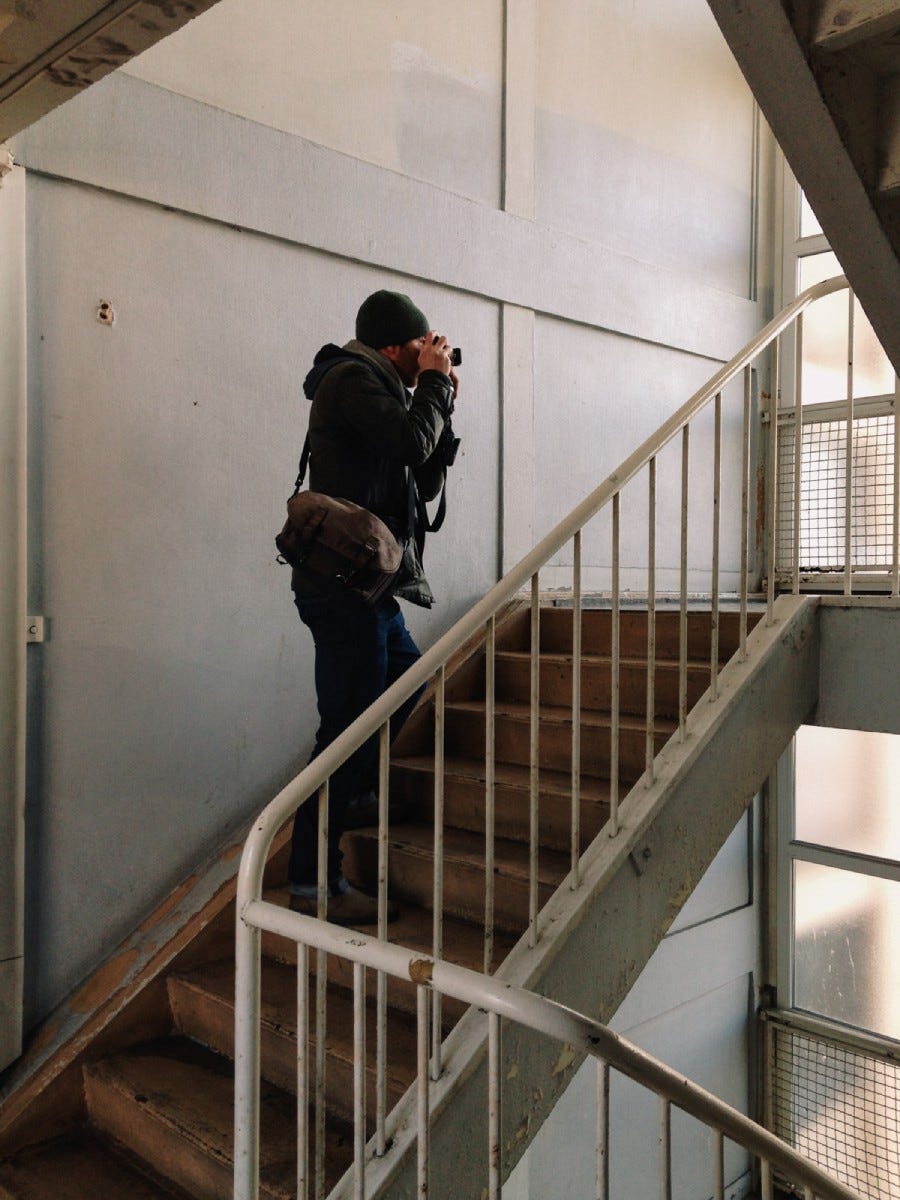
Hello.I am Marc Wilson, a photographer working out of the UK.
I work on long term documentary projects based around memory, history and landscape, based around subjects including The Holocaust, the Second World War and the current war in Ukraine.
Over the last 15 years I have made 6 bodies of work (and published as 6 photo books) and have had numerous exhibitions both here in the UK and beyond, including Greece, India, Israel, France and Belgium. As well as books and exhibitions I also give talks about my work and see them as a natural extension of the book and exhibition formats for sharing work with a wide audience.
Technical
Do you think technique is important?
Very much but simply to allow you to show the subject you are photographing in the way you want to, without limitations. So for me the point of technique is very important, but not in an empty way. Not style for styles sake, but for the purpose of the visual language you choose to use as a photographer. What you see does not rely on technique but empathy, listening and research.
What equipment do you use?
35mm, medium format and large format - Leica, Hasselblad, Arca Swiss.I’ve always chosen the format that fits each project best, both in terms of the technical aspects of the camera but more whether it feels right for me, bearing in mind the subject matter and practicalities.
And what software?
Photo Mechanic, Lightroom, Photoshop, Affinity Publisher.
How do you edit your photos?
For me editing means choosing and sequencing images for a book. I work on screen only initially to choose 100-150 images from those made and then make small 6x4 inch prints of these that I then layout on a table / floor to edit and sequence from. Is that what you meant by editing :)If you mean processing (of my digital images / scans) then I do as little as possible, simply aiming to show what I saw / felt at the time I made the photograph.
Inspirational
Where lies your heart?
I try to make work in the way I live my life. Sharing stories about subjects that I feel are important, in a subtle and sensitive way. I love the process of making work. The thought, research, travel, walking in the landscape / cities and meeting with people and the conversations it leads to. The very act of making the picture can be so calming and overpowering all at once, as I like to give it all my concentration, to focus completely on what I have seen and then frame through the viewfinder.
Do you have your own style or signature?
Not by design necessarily, but one that initially came out of my way of working with the choice of subject matter, and that has led into all my other work.
Where do you get your inspiration from?
The world around me but also through conversation and looking at other work. But once on location I also like to let the location ‘talk to me’. I know that sounds a bit odd but it’s the idea of spending time in a space before I make any photographs. Getting to try to understand and feel the locations, what parts of it speak to me about the subject I am dealing with. Which composition, what details helps tell that story. That ‘time’ varies from each location to location and project but even with a limited time you can still make it work for you, by looking before you even take your camera out of it’s bag. That is a really important part of the process of making work for me.
Does your project start with an idea or with a loose image?
Always an idea or a feeling, every single time.The idea, followed by research and discussion and then the initial photographs to see if the images will work in the way I want them to…and if they do not , more work to find the way in that they do. I will then continue with further research as I start to make work on location, building up the body of work as I go along.
When is your project finished?
A variety of reasons. Sometimes the content, sometimes it is time related, but always when I feel it is right in the way that the images I have are enough to talk about the subject matter in the way it needs.
During your project, do you already know how it ends?
Not always, as I am finding new locations and stories as I go along. In my more recent work on Ukraine I have made there are certainly ways in which I would hope it to end, but they have not yet.But I always know what the work is about at the very start.
What is your favorite photo and why?
I have never really liked choosing one photograph over another as I don’t want to place more important in one location / story over others.But it is a question I am always asked.
Early on the in the 6 years of making 'A Wounded Landscape - bearing witness to the Holocaust’ I visited a location in Poland to make work. The Chelmno death camp and the connected Rzuchow forest area. This is the area where the prisoners were taken in vans from the village to the forest - and murdered through gassing along the route. In this cleared forest area, as well as areas marked out as the mass graves / pits, along the edge of the footpaths, you also see bone fragments seeping up out of the sandy soil. The bodies of the prisoners whom had been murdered were then exhumed, burnt, crushed (with specially created machines) and their ashes dumped in the local river in an attempt by the Nazi’s to destroy any evidence of what they had done. But some of these bone fragments now seep up out of the ground. Making this and other more detailed images of the bodies, I cried. These were, up until that moment, the hardest images I had photographed. But what I was looking at forced me only more to continue and make this work. It is an image, and a body of work I can speak about for hours.
Future
What do you want to achieve
Happiness and knowledge.I want to live a life that brings joy and security to my family. I want to change the hurt and stop the wars but I can’t do that. What I can do is my bit. Using the skills I possess to open eyes, share stories, try to make a little difference and in doing that bring hope and comfort to my family, my friends and others.
And if we all do that…
What do you want to know from others? You may ask one photographer one question. What would that be?
So many photographers I’d love to ask. So I’ll say one that is not possible.Robert Frank, as his book The Lines of my hand, was one of my first and still favourite photo books.
How did he feel making his work, what did he hope to achieve with it, did he ever feel he was good enough?
Where can we see more
All my projects and photobooks can be seen on my website at www.marcwilson.co.ukA website really is the best place to see it all…and you can buy my books from there also :)
P.S. Marc Wilson will also be featured in the 7th issue of Darkrooms Magazine, which will be out on the 1st of April.
That’s it for this newsletter
Do you like this interview? Do you want to see more? Send my some suggestions for photographers you like to see interviewed at Darkrooms. Of course you can suggest yourself if you have an interesting story to tell.
Till next time,
DARKROOMS is a reader-supported weekly photography newsletter celebrating visual storytelling. Become a free subscriber to never miss an issue, or upgrade to a paid subscription to receive all high-resolution editions of Darkrooms Magazine, exclusive e-books, and fuel the creation of more photography content you love.


Thank you. Great stuff.
Fascinating interview. I have a number of his carefully designed books on my shelf. They all say something - in particular the intensely moving opus ‘A Wounded Landscape.’