

The viewer completes it
Where the photograph ends and the story begins

One image, or a world
There is such a thing as the perfect photograph. An image that says everything, that stops you in your tracks. One that stays with you long after you’ve seen it. Those photographs exist, and they are rare. We can all call a handful of iconic images to mind and sketch them from memory.
But even the strongest single photograph has a fundamental problem: it stands alone. The viewer brings their own context, their own memories, associations and prejudices. Two people look at the same image and see two completely different things. That can be a strength. But if you want to tell a specific story, it’s also a risk.
A series solves that. Not by giving the viewer less freedom, but by offering direction. The second image responds to the first. The third reframes what you thought you understood. A pattern emerges, gets confirmed, or gets broken. You’re not telling the viewer what to think, but you are offering them a route.
What happens between the images is at least as important as the images themselves. The white space, the turn of the page, the step from one frame to the next, that’s where the narrative tension lives. That’s where the viewer starts asking questions. And questions are the beginning of engagement.
That doesn’t mean a single image is weaker than a series. They’re simply different instruments. A single image is an exclamation. A series is a conversation.
And a good conversation is harder to forget.
Words that carry photographs. Or suffocate them
There’s a constant misconception in photography: that an image which needs text has somehow fallen short. As if the need for words is a weakness, an excuse for what the image couldn’t say on its own.
I don’t think that’s right. The question isn’t whether you use text, but when, and how.
Some images are entirely self-sufficient. They carry their own context, or they create a world that needs no explanation. Words would only get in the way, fixing what should remain open. A caption beneath a strong landscape photograph tells the viewer what to feel, and takes away precisely the space your image was trying to offer.
But there are also stories that remain incomplete without text. Not because the images are weak, but because your content demands it. When you’re photographing a complex social subject, when figures or names or data are an inseparable part of your story, text isn’t a patch, it’s an ingredient.
The subtlest use of text is perhaps the title. One word, or a short phrase, that doesn’t explain the image but shifts it. That adds a second layer which wouldn’t exist without those words. An image of an empty chair means something. That same image titled He’s not coming back means something else. The photograph hasn’t changed. The experience has. I played with this in an older series ‘What remains’, where the captions described what used to be there, not what you actually see in the photograph:
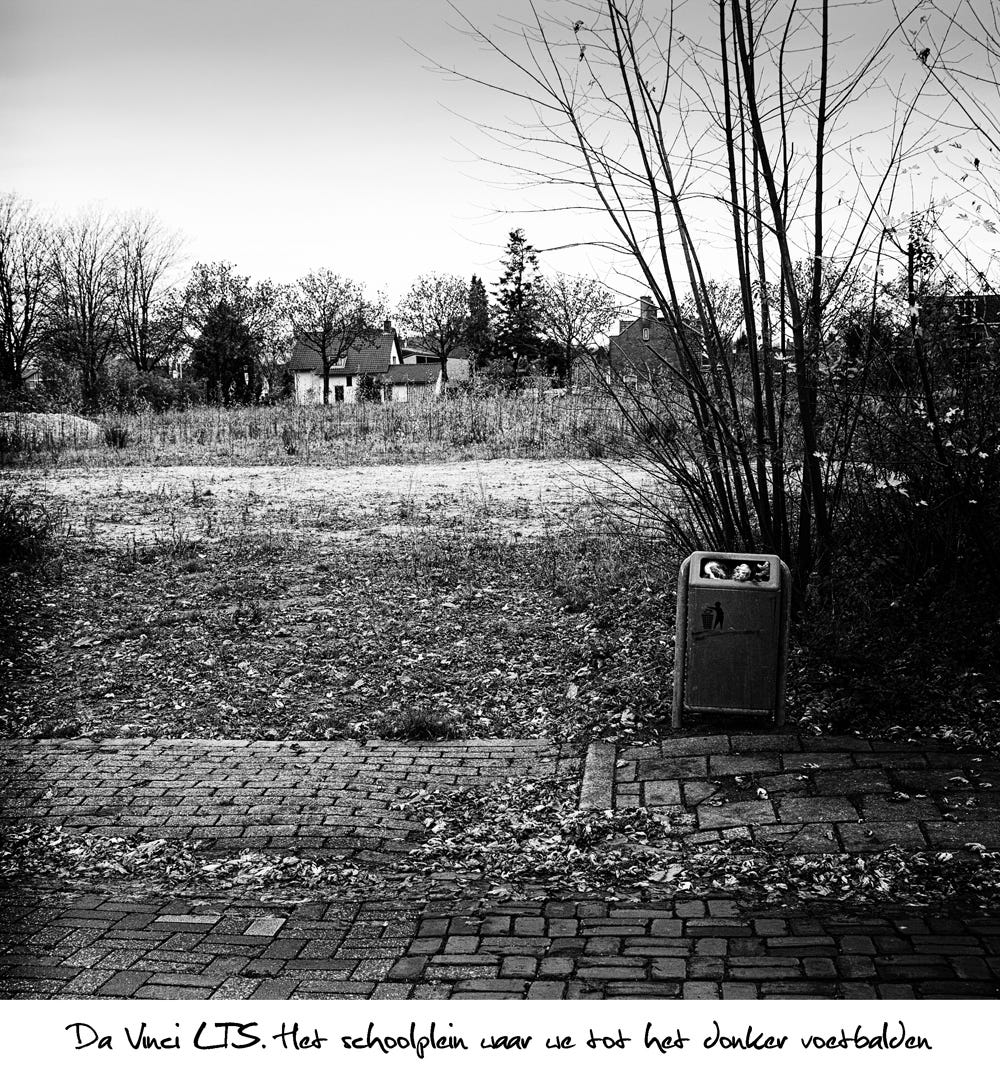
For anyone publishing in a magazine, a book or a newsletter, this is a daily consideration. How much do you trust your image? How much space do you give the reader? And where does your story need words to land?
There’s no universal answer. But making that choice consciously, rather than adding text by default or leaving it out by default, is the difference between a caption and a narrative.
The story only exists when someone looks
A photography project that nobody sees tells no story. That sounds trivial, but it has an important consequence: the viewer is not a passive recipient. They are an active part of your story.
Every viewer brings their own baggage. Their cultural background, their personal memories, their knowledge of the subject. Two people looking at the same project can reach fundamentally different conclusions, and both are right. Not because your story is vague, but because meaning always emerges in the encounter between image and viewer.
This isn’t a problem to solve. It’s a quality you can work with.
When you know your audience, you make different choices than when you work in a vacuum. Not to steer the viewer towards a predetermined conclusion, but to create the right tension between what your image offers and what the viewer brings themselves. Too much explanation kills that tension. Too little, and the viewer walks away.
The hardest part is that as a maker you are always too close to your own work. You know what you meant, because you know the context and you put in the effort. That knowledge is valuable, but it also makes it difficult to see what an outsider actually experiences.
That’s why feedback isn’t a luxury, it’s a tool. Not to get your work approved, but to find out where your story lands and where it gets lost. I’ve written about feedback and showing your work to others quite often, like in my third(!) weekly Darkrooms-post (back in July 2022): Why you should show your photos to many people
Ultimately a story isn’t an object you make and deliver. It’s something that comes into being again and again, every time someone looks.
Let me know your thoughts
Till next week,
Love visual storytelling? Support Darkrooms. Your support directly fuels the creation of more photography content you love.
Excellent piece, Marcel. It touches on a subject I’ve wrestled with myself and keep coming back to. Sometimes I start writing a text, then shorten it, and eventually remove it altogether. Other times I begin with the intention of writing an essay, only to end up with something closer to poetry.
I love it when there are only images, but occasionally I wonder whether that is simply the path of least resistance, as if I haven’t put enough effort into expressing what I experienced.
On the other hand, writing about an experience without imposing anything on the reader is a challenge in itself.
Thank you. It's always food for thought and something to consider for the next post.
I didn't realize that making a choice between a caption/no caption and a title influence the viewer. It's worhwile to take that into account. I love this kind of insights and point of view