

Darkrooms Uncovered - Cedric
A peek into a photographer's mental creative darkroom


What does your creative ritual look like? Do you have specific habits or conditions that spark your creativity?
First, I need to make clear that I don’t consider myself an artist and I don’t think of creativity as something specifically linked to artistic endeavours. For me creativity is the process through which ideas are connected in new ways and it applies to every day life, to work, to scientific research, and to art.
I don't have a ritual per se. I don't have a room, I don't have a procedure, I don't have any artifacts that helps me release creativity. If anything, my ritual is not to have a ritual.
I'm a strong believer that creativity comes from mind idleness (aka boredom), in activating the Default Mode Network (a set of regions in the brain that get activated when you don't think about anything voluntarily). By letting your mind wander when you have nothing to think about, you let your brain make connections and raise ideas that wouldn't have surfaced when the Executive Control Network was in charge.
In other words, I let my mind be bored once in a while.
When you're feeling creatively blocked, what's your go-to method for breaking through?
I don't fight it and walk away. I learned when I was a kid that forcing your brain to solve a problem usually hits a wall and is an inefficient way to reach a solution. It’s a bit like trying to force a cat to eat food it doesn’t want.
I strongly believe in the preparation, incubation, illumination, verification cycle (Graham Wallas): learn about what you want to find a solution to (and creativity is a problem to solve for me), let it simmer at the back of your brain for a while (including when you sleep), then eventually your unconscious mind will come up with a solution.
There have been any studies on the subject that show that this is a powerful way to clear creativity blocks.
Describe a moment when your creative perspective shifted dramatically. What triggered it?
One day I was out making the kind of photographs I had done for 20 years: landscapes with nice colours, sunrises over the sea, the whole aesthetic package. And it dawned on me that none of it mattered. The whole process and the resulting object were utterly futile. I realised that documentary photography was the only kind that was self-justifying.
The idea probably brewed in my mind because of discussions about generative AI and the fact that it could recreate any photo. If that's the case, then the only thing that it can't do is replace the photography that requires presence.
If your job is to record rather than invent, where is the creative input? Instead of trying to solve the problem “how can I make this place look nice”, your creativity then tries to solve the problem “how can I convey this feeling, this situation, this event”. That’s a much harder problem. The creativity doesn’t disappear. It moves from the decorative to the communicative.
What recurring themes or elements do you find yourself naturally drawn to capture?
The recurring themes in my photography have changed over time, as you can expect from the evolution of what my understanding of what photography is and its place in the world.
Originally, when I was interested in landscape photography (which really meant mainly seascape photography), I would look for what pleased me aesthetically because photos for me were things to look at and get a nice feeling. The main themes were:
- The sea, waves, beach.
- Rocks in the sea with long exposures.
- Sunrises.
When I understood that photography should be about evidence, experience, presence, and aestheticism should serve the message rather than being the whole point, then the themes became:
- People and their activities.
- Time, its passing, and effect.
- What happens int he world.
Now I’m more thinking about photography in terms of projects. A lot of these revolve around capturing people’s life, family, and memory.
What non-photographic influences (books, music, films, etc.) most impact your work?
I have fairly few external influence today. When I started, the great landscape photographers (e.g. Ansel Adams, Colin Prior who was a local to me) were a major source of my understanding and I wanted to emulate them.
Now I’m in awe in front of war photographers, especially women who encounter additional barriers (e.g. Dickey Chapelle, Jackie Spinner, Lynsey Addario, Anja Niedringhaus, to name a few), who risk their lives to show events that most of the world doesn’t know and doesn’t want to know about. But they’re not an influence on me since I don’t have half of their courage and I won’t try to emulate them.
My way of thinking, influenced by a part of autism, means that different areas of life don’t mix for me. I don’t understand how books, films, or music could influence my photography. To me they are very different domains that don’t cross-pollinate.
What photograph of yours feels most personally revealing, and why?
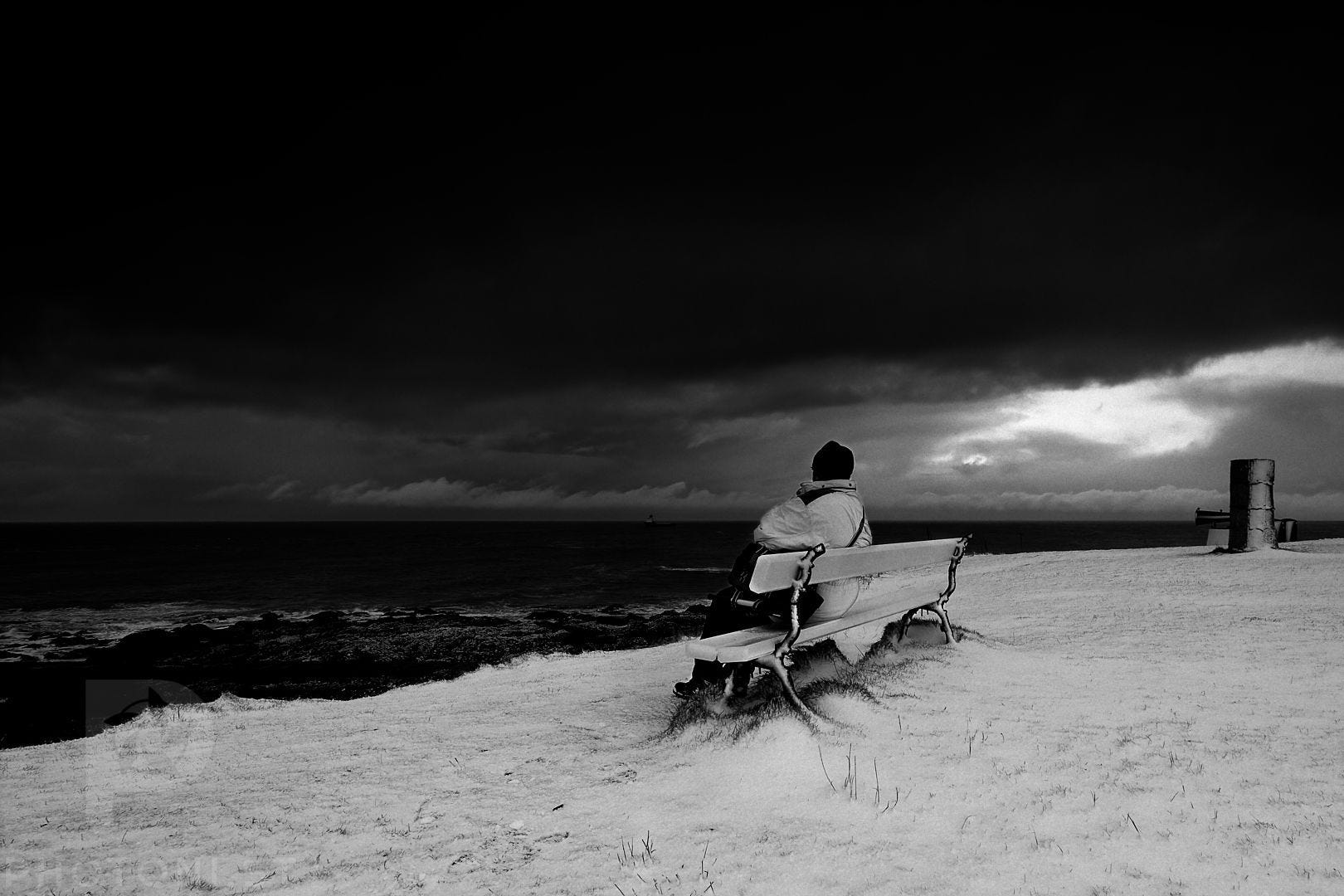
I like a self portrait I took many years ago where I was sitting on a bench on the beach in the snow one early morning, with a storm coming on the horizon. It evokes solitude, landscapes, the sea, photography (I have my camera bag with me), and quietness. It also somehow bridges my old photography habits (landscapes) and my new endeavours (documentary).
If you’d like to read Cedric’s full answers – it’s a lengthy but interesting article – do have a look at this post this post
Find out more about Cedric
Website: https://photoni.st
Substack: I may be wrong
Browse the full collection of 34 interviews
Thank you for being part of our community!
Your support directly fuels the creation of more photography content you love.
 | A guest post by
|
Great interview!
A GREAT interview. Q3, for me, highlights the difference in impact and long-term "viewability" between a dopamine hit / pretty landscape and a landscape which "documents" mankind's impact on the landscape.