

Context and ignorance
A guest contribution on context in photography


This is the first guest contribution to Darkrooms. Besides the contributions with photographers in the Uncovered interview series, this post is completely written by a guest author, photo friend Kees Molders.
”The recent comments in PhotoTalk remind me of a short essay I wrote a few years back. I adapted its text for Darkrooms. It is about ‘context’ in photography.There was a time when the Dutch daily newspaper Trouw had space in the weekend-supplement for a cliché or common wisdom in which someone was invited to recite a motto, which was then explained in a mini-interview. On 21 November 2015, rapper Sef entrusted the saying ‘Context is everything’. At the time I was preparing a lecture for my photography club about Francesca Woodman, on the occasion of the opening of ‘her’ exhibition at Foam (Photography Museum Amsterdam), ‘On Being An Angel’.
Nowadays, research for an introduction or essay is conducted on the internet and – let’s not forget - in books. After typing in the keywords ‘Woodman’ and ‘essay’, a great deal can be found on the internet, more than is needed for a simple story. It is striking that in the vast majority of articles, whether they come from renowned curators or secondary school pupils, the first sentence is invariably a variation on ‘Francesca Woodman was a promising photographer who committed suicide at the age of twenty-two’. This context is apparently so dominant for writers that they invariably begin their texts about Woodman with that fact. Knowledge, or perceived knowledge, influences the way we view a work of art: that is why it is called context. The annoying thing is that once knowledge has been acquired, it is difficult to push it into the background, especially when it is something as dramatic as the self-chosen death of a young woman/man/artist. You cannot un-know something like that: today ChatGPT behaves in a similar fashion.
Within my photographic society, as in most photography clubs, it is customary to discuss photographs. Members can submit their work, which is then discussed by fellow-photographers. I had submitted the accompanying image.”
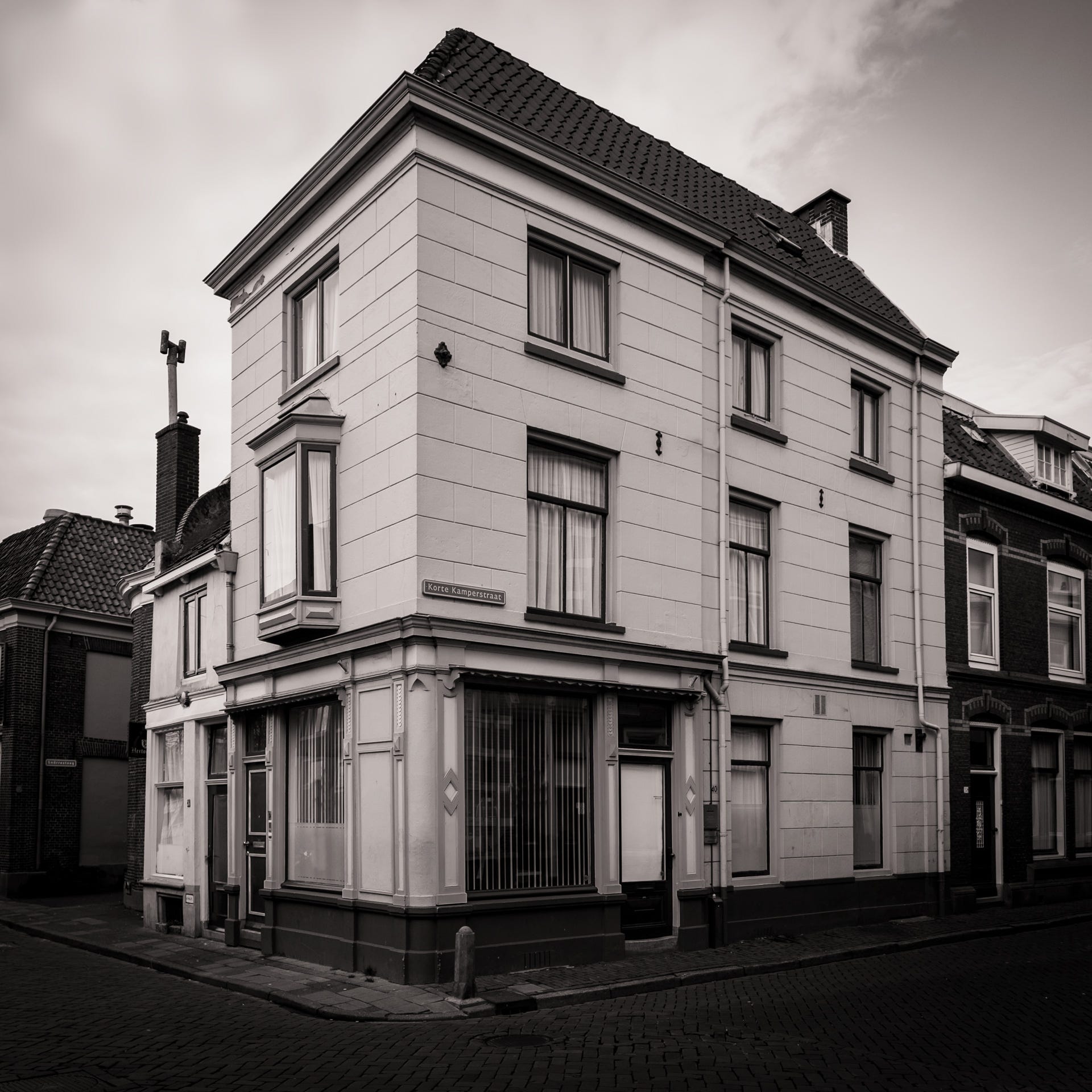
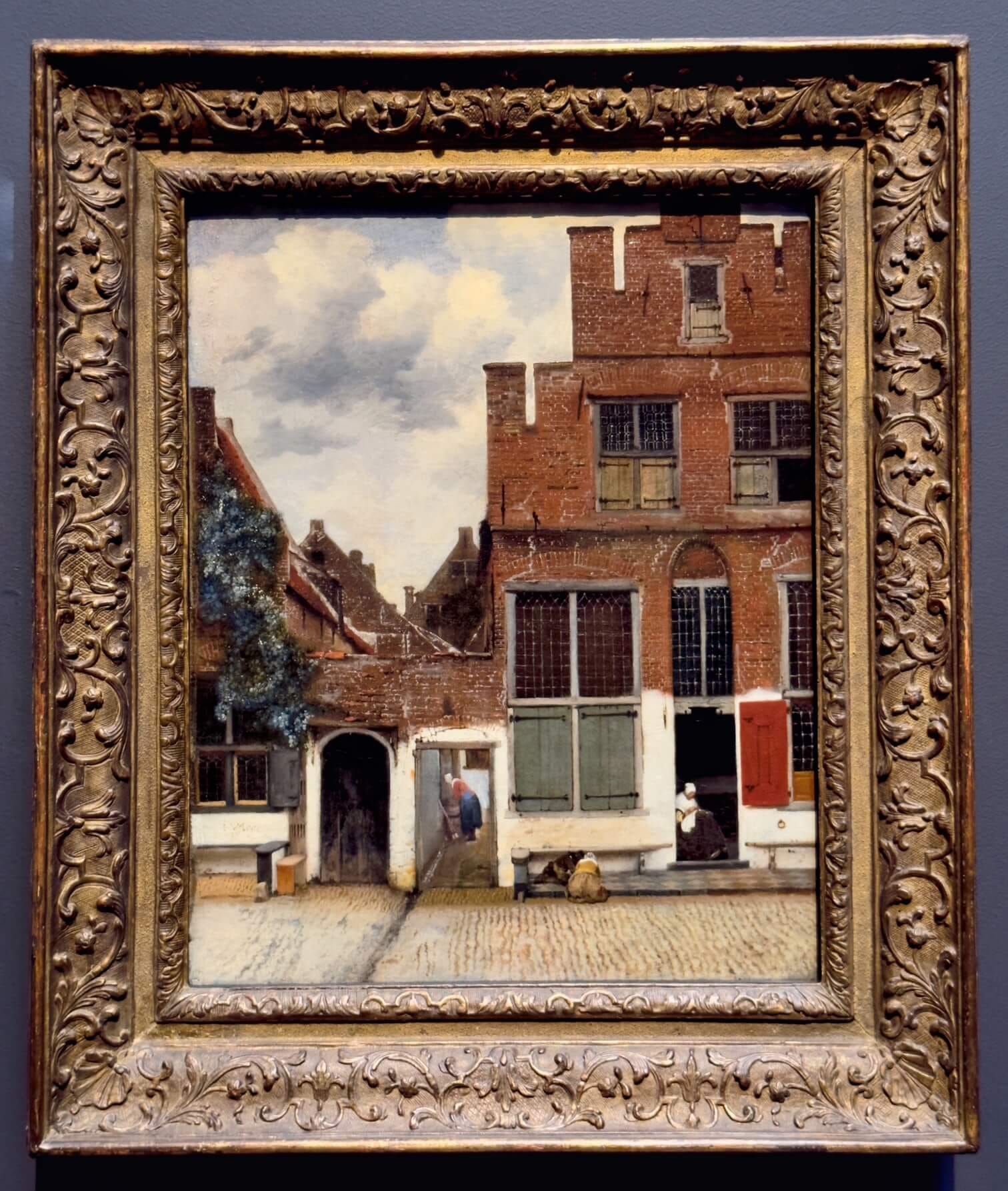
”In an image processor I had removed cables from street lighting, a moped, advertising behind the windows, etc. But I hadn’t erased the street name sign, and that turned out to be an irresistible bait for the photo detectives to go Streetviewing. In no time at all, they knew exactly where to find the building. Wherever you are in the world: try for yourself, the sign says ‘Korte Kamperstraat’. Now the question is: how important is that? Why would anyone want to know that at all? Shouldn’t a photograph be able to stand on its own without additional knowledge – apart from journalistic or documentary photography? I was surprised by the unintended characteristics that my photograph turned out to have, which apparently distracted attention from the content of the image. The findings were correct, but in my opinion irrelevant and actually quite distracting. I vowed to give my next corner building completely fictitious street names...Shortly before that, researcher Grijzenhout found the exact address of the 17th century Johannes Vermeer painting ‘Straatje’ (the little street, in the city of Delft – see Wikipedia). The most important characteristic of the painting is that it is a Vermeer. And people like the painting. Newspaper columnist Schouten expressed his surprise about the search for the street name and the specific building. What exactly do you need to know to discover the truth, he wondered: the discovery of the correct address did not really affect him, nor did he feel the urge to take the next train to Delft.
In fact, there is a quote from the researcher, in response to the question of how we can be sure that the facades were exactly as Vermeer painted them, given that 17th-century landscape painters manipulated their work. ‘We don’t know. But that’s always the case. I went looking for a place that matched the painting exactly. Well, I found such a place.’
The grateful Rijksmuseum curator paid no attention to such a subtle nuance: ‘The answer to the question of where Vermeer’s ‘Straatje’ is located is of great significance and will have far-reaching consequences, both for the way we view this particular painting by Vermeer and for our image of Vermeer as an artist.’
Far-reaching consequences! Well, that’ll get you on the eight o’clock news.“
“My argument is that context can be created. Or even: the actual or perceived context of a work of art can be hyped.
Take the story of nanny Vivian Maier. All that fuss about the auction and the undeveloped rolls of film, the discoverer, the documentary, the lack of family – hold on, wasn’t there a distant heir in Switzerland? It’s good that she has been ‘discovered’, it’s a wonderful story, but with so much context, you might forget to look at her photography: what was the atmosphere of the era she captured, what is the substantive quality of her art? The phenomenon comes to the fore, her photography initially recedes completely into the background.Back to Woodman. The thing about Woodman is that there is excessive speculation, interpretation and psychologising about her death in the margins of ‘context’. Many articles draw a connection between the mood in her photographs and her suicide: you can see that, can’t you? In one selfportrait, she is seen crouching against a wall, naked, with a lily around the corner. Comment found: Woodman in an embryonic position, this photograph is a harbinger of her death, because we all know that the lily is a symbol of death, no wait, maybe she is reflecting on her own female sexuality here, because we all know that the lily is a symbol of the female genitals...
Well, that helps. Our tendency to look at photographs like detectives has gone from analysis to misinterpretation. Too much context – especially questionable context – gets in the way of looking at photographs with an open mind. Context should not be a burden.
I am curious to hear your thoughts on the subject. Can you refrain the urge to know more, to just let it be, to accept a photograph for what it is? Does a photograph need explaining?”
― Kees Molders
Discover your city through Urban Exploring
What happens when you let randomness guide your photography? Photographers worldwide are using RBNXPLRNG to see their cities differently - 5 photos, random turns, fresh perspectives. Try it yourself.
Till next week,
Love visual storytelling? Support Darkrooms. Your support directly fuels the creation of more photography content you love.
📸 Get me a roll of film
This is the most important article I've read on photography in a long time. I am irritated when someone looks at a photograph I’ve taken and asks where it was taken, as though that context will make a substantial difference to the way they look at the picture. However I find that when I look at a photograph I will often fall into the same trap. Your words about Vivian Meier resonated with me: am I drawn to her pictures qua pictures or is my attraction based more on her back-story? Is her back-story even relevant to looking at her photographs? The same problem occurs with “forged” artworks: is a picture only good (and consequently “valuable”) if it is by Vermeer rather than Van Meegeren?
You final questions: “Can you refrain the urge to know more, to just let it be, to accept a photograph for what it is? Does a photograph need explaining?” are very important. I think we have to try as hard as we can to be “innocent” of context (unless the picture is photojournalism where context is a major and important part of the picture). I also think ignoring context and back-story are very, very difficult to do consistently. I’m going to have to keep on trying …
I think that wanting to know where a photo/painting was taken is related to a trend, where we are becoming less and less interested in art forms in general. Investing time in accepting what is there, making an effort, and trying to understand the message are becoming less and less common these days. The result is fleetingness.
Moreover, as Kees points out, we find it increasingly difficult to comment on the artistry of a photo/image/painting, because this is subjective and therefore also says something about the critic. No, it's much more comfortable to comment on the (faltering) technique, something that someone else can also observe, relatively objectively.
When I think of photography, I immediately think of (un)focus; skewed horizons and violate the rules of composition. An easy distracting manoeuvre is asking what the image represents, or where the photo was taken. Better yet: spontaneously noticing the latter as a viewer, thereby demonstrating one's own general knowledge.
No, images don't need that context, add nothing, and are indeed distracting. And just let Korte Kamperstraat (or any other specific landmark) remain. It's easier to ignore the know-it-all's unsolicited commentary than to try to change them.
You can't teach a shrimp to play guitar either.